Most young adults start their first salaried job with a stack of HR paperwork and nobody to explain it. Somewhere in that stack is a 401(k) enrollment form with twenty to fifty investment options on it, and the choices they make on that form in the first week can be worth hundreds of thousands of dollars by the time they retire.
If you've got a 22-to-28-year-old who just landed their first salaried job, here's the ten-minute version of what to walk them through before HR's default settings make the decision for them.
The default enrollment
On day one, HR drops a folder in front of them with a benefits packet, a 401(k) enrollment form, a health insurance selection, and about six other things. They're jet-lagged from a week of orientation, they don't want to look dumb, and they've got two options in front of them: enroll at whatever the company default is (usually 3%), or skip it and "come back to it later."
Both are wrong. The 3% default is almost always below the employer match, which means they're leaving free money on the table every paycheck. And "I'll come back to it later" turns into two years of not coming back to it later. Your job as the parent is to make sure they don't do either one — that they fill out the form correctly the first week, and then don't touch it again.
Rule 1: Contribute at least up to the employer match
This is the whole ballgame, and if you only get one thing across in the conversation, make it this one. If the employer matches 100% of the first 4% of salary contributed, the kid needs to contribute at least 4%. If the match is 50% of the first 6%, they need to contribute at least 6%. Whatever the match formula is, hit the number that captures all of it.
The reason is simple: the match is part of their compensation. The company already agreed to pay it. If they contribute below the match threshold, they are literally telling their employer "keep some of the money you agreed to pay me." Nobody would ever do that on purpose, but people do it by accident every single day because they didn't fill out the form right.
On a $60,000 salary with a 4% match, skipping the match costs them $2,400 a year — every year, for as long as they're at that job. That's the single most expensive mistake young workers make, and it's completely avoidable.
Rule 2: Roth, not traditional, in your 20s
The enrollment form will ask whether they want a Roth 401(k) or a traditional 401(k). Most companies now offer both, and most young workers have no idea what the difference is.
The short version: with a traditional 401(k), they get a tax break now and pay taxes when they pull the money out in retirement. With a Roth 401(k), they pay taxes now and pull the money out tax-free in retirement, including all the growth.
In your 20s, you're almost always in a low tax bracket — probably 12% or 22% federal. That's about as low as your tax rate is ever going to be. Paying taxes now at those rates, and letting forty years of compounding grow tax-free, is a much better deal than getting a small tax break now and paying taxes on a much bigger number later. Roth usually wins in your 20s for that reason, and it's the default recommendation I give my kids.
The employer match, by the way, always goes in as traditional — that's a tax rule, not a choice. But their own contributions should go Roth while they're young.
Rule 3: Pick a target-date fund and stop worrying
Now comes the part that makes people freeze: the investment menu. There will be somewhere between twenty and fifty funds to choose from, with names full of jargon they've never heard.
Find the fund with a year in the name that's closest to when they'll turn 65. If they're 24 today, that's roughly a 2065 or 2070 target-date fund. Put 100% of their contributions into that one fund.
A target-date fund is a pre-mixed portfolio that starts out aggressive when retirement is far away and automatically gets more conservative as they get closer. The fund manager handles all the rebalancing and the shift over time. It's designed exactly for the person who doesn't want to think about it, which describes basically every 24-year-old with a first job.
Once they've picked the fund, tell them to close the app and not look at it. Checking a retirement balance in your 20s only leads to two bad outcomes: panic when the market drops, or the urge to get clever with the allocation. Neither one helps.
Rule 4: Do not touch it. Do not borrow against it.
Somewhere in the first five years, they're going to hit a moment where the 401(k) balance looks like real money and they'll get an idea — a down payment, a wedding, paying off a car, starting a business. Or the plan will let them take a loan against it, and that will sound harmless.
The answer is no. Not for any of it. That money is doing exactly one job: growing for forty years so it can be a much larger number at the end. Pulling it out early triggers taxes and a 10% penalty, and even a 401(k) loan (which sounds better) resets the compounding on whatever they borrow and creates a real mess if they leave the job before it's paid back.
Whatever the emergency is, there's another way to handle it. The 401(k) is not the emergency fund.
The Compounding Math
If any of this feels too abstract or too far away, pull out the compounding math. A small amount invested each paycheck can turn them into millionaires when they retire - or could let them retire early.
Let's say your child is paid every two weeks and puts $100 of each paycheck into the 401(k). On a $60,000 salary, that's a little over 4%. Here's what that turns into, starting at 23, at three different average returns. In 40 years they'd have over a million saved for their retirement!
$100 a paycheck
| Time investedPaid in6%8%10% | ||||
| 20 years (age 43) | $52,000 | $98,374 | $123,496 | $155,956 |
| 30 years (age 53) | $78,000 | $211,421 | $305,714 | $447,907 |
| 40 years (age 63) | $104,000 | $413,871 | $699,108 | $1,205,152 |
| 42 years (age 65) | $109,200 | $470,535 | $821,052 | $1,463,952 |
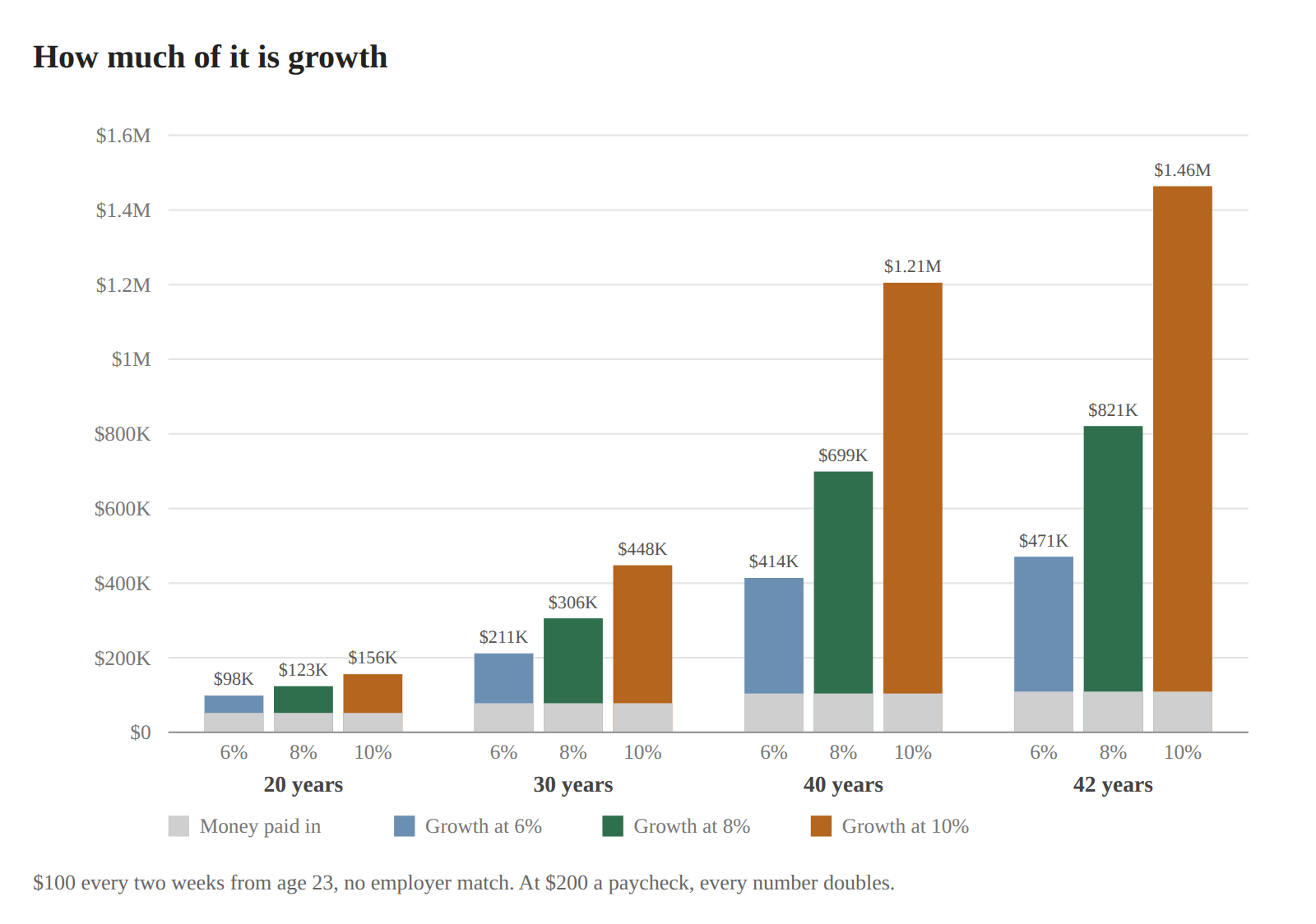
None of these numbers include the employer match. If the company matches dollar for dollar, every number in the $100 table doubles, so $100 a paycheck at 8% becomes about $1.6 million by 65 instead of $821,000. A 50% match adds half again, which puts that same example at about $1.2 million.
Look at what happens between year 20 and year 40. At 8%, $100 a paycheck grows to about $123,000 in the first twenty years. In the next twenty it grows by another $575,000, even though they only put in another $52,000. Most of the money shows up at the end, and it only shows up if the early years are in place.
That's why the conversation matters right now, in the first week of the first job, and not five years from now when they finally get around to it. Every year they wait costs them money at the back end, and the only lever that fixes it is time.
Leave a comment