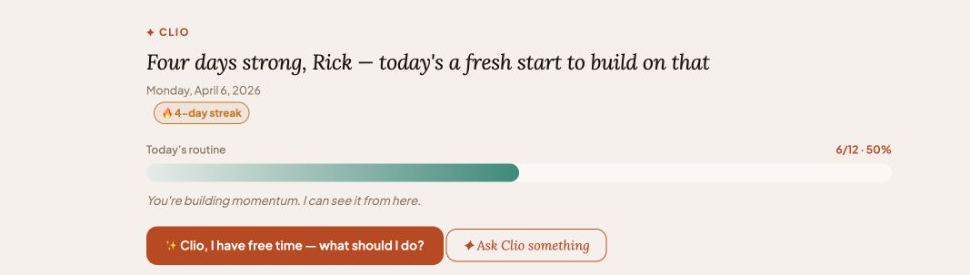
I built an app called Cliopanion. It's a daily-routine app with an AI companion named Clio that tracks your routines, holds you to commitments you've made, and reflects with you on how the week went. I built it because I have ADHD and couldn't find anything that did quite what I wanted.
Habit apps don't know you — they hand you a checklist and a streak counter and that's about it. Journaling apps know you a little better, but they don't push back. Nothing was sitting in the middle, where something remembers what you said you'd do, notices when you stop doing it, and says something about it.
So I built that middle thing.
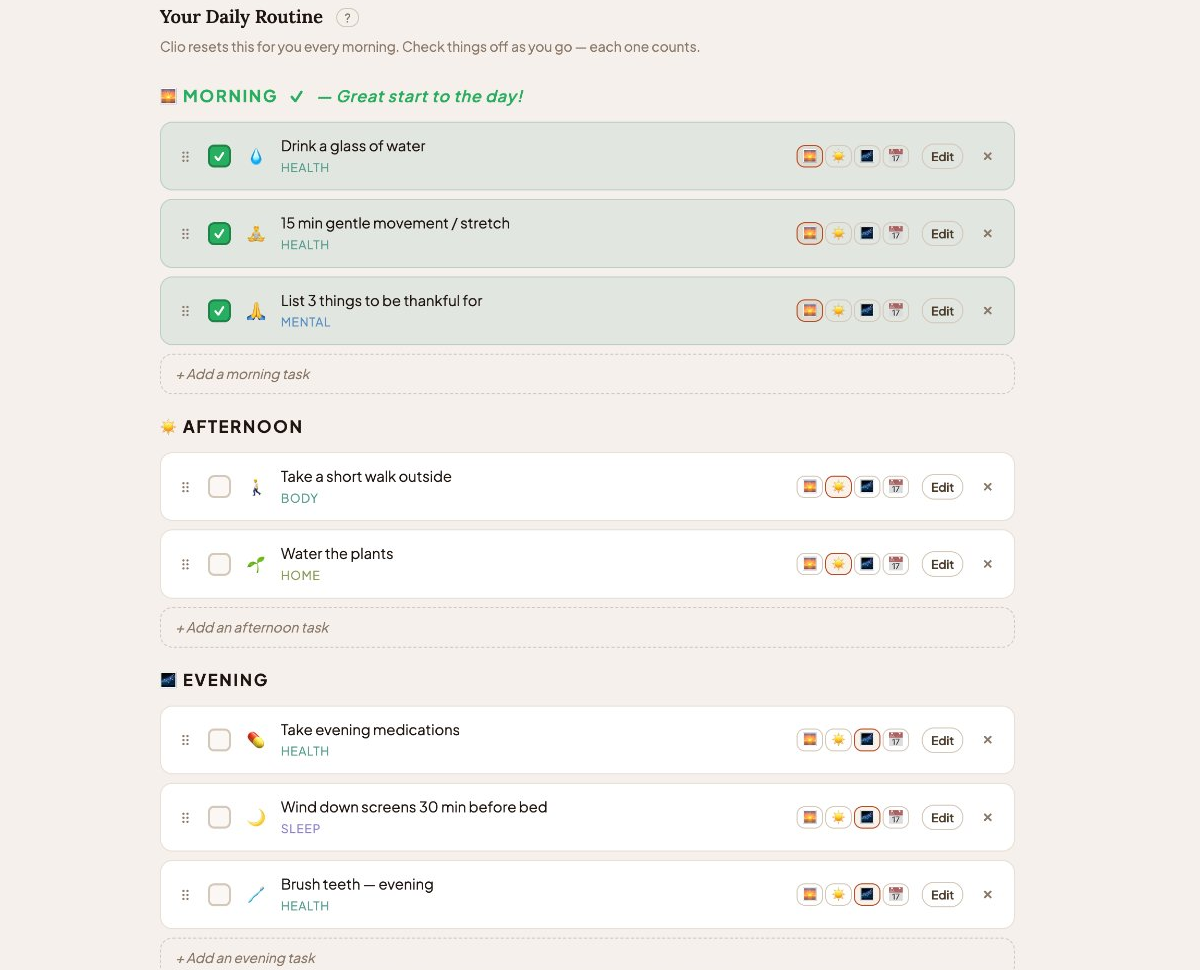
How the routine is structured
Your day in Cliopanion is split into morning, afternoon, and evening. You set up the routines you want in each block — exercise, reading, a walk, meds, whatever — and check them off as you go.
The AI chat knows your patterns
Clio is the AI companion built into the app, and the chat isn't generic. She has the context of your routines, your check-ins, your commitments, and how the last few weeks have gone. So when you open the chat and say you're feeling off, she can say something useful — like noticing you've skipped your morning walk four days running, or that your sleep routine fell apart the week your work got busy.
That's the piece that wasn't possible a few years ago and is straightforward now. The AI has the memory of your actual life inside the app, not just whatever you typed into the chat box today.
Commitments — the promise-to-your-partner feature
This one came out of real life. You tell your partner you'll stop leaving dishes in the sink. You mean it when you say it. Two weeks later you're back to leaving dishes in the sink and neither of you can quite remember what was agreed to or when.
In Cliopanion you can log a commitment — to yourself, to your partner, to your kid, to your boss — with the date and what you actually said. Clio holds onto it and checks in with you about it over time. It's a small feature and it's the one that's gotten the strongest reaction from people, because everyone has a version of this.
Personas
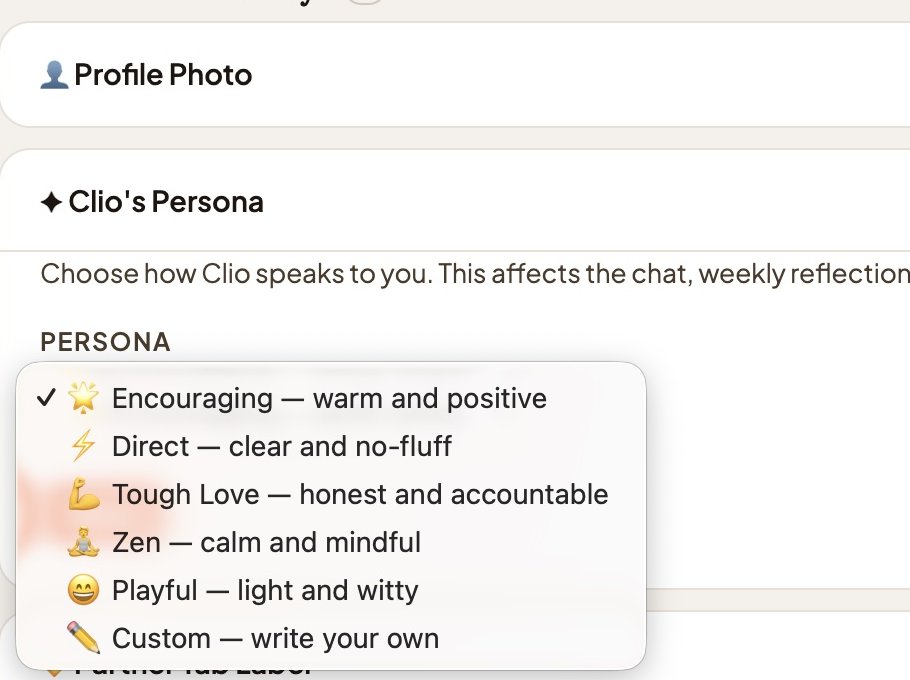
Clio has a few different personas you can switch between, depending on what you want from her on a given day. A gentle one. A direct one. A coach-style one that pushes harder. Same memory, same context, different tone. I went back and forth on whether to include this at all and ended up keeping it because the same voice doesn't fit every mood, and forcing one tone on people felt wrong.
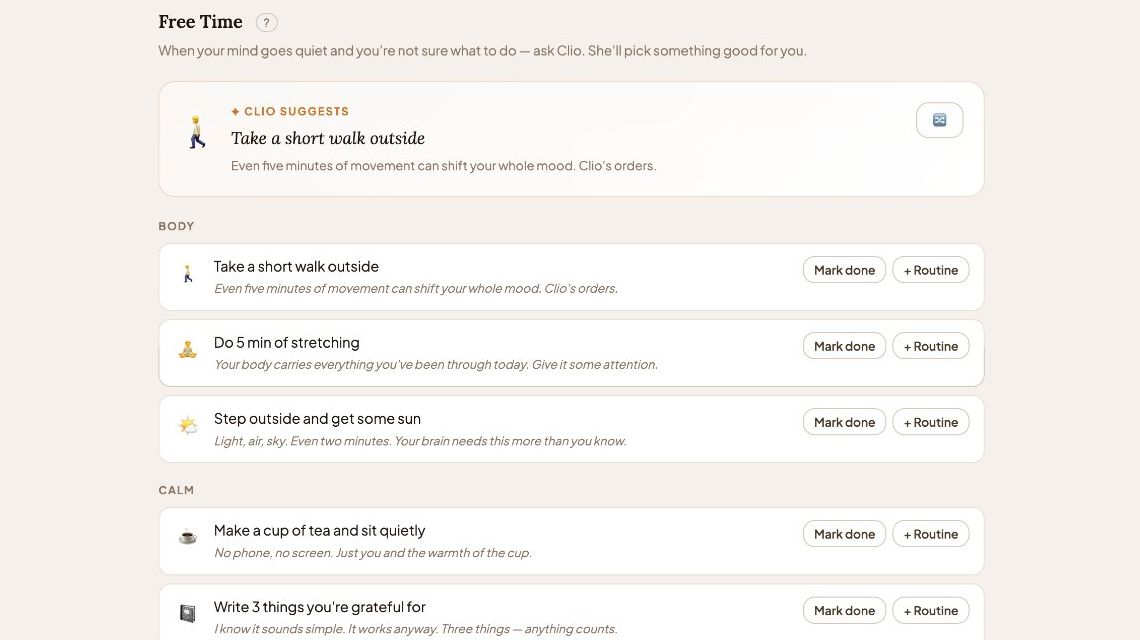
Free-time suggester
You tell Clio you've got two hours free this afternoon and don't know what to do with them. She looks at what you've been meaning to do, what you've been neglecting, and what you said mattered to you, and suggests a few things. It's not magic — it's just that she has the context to make a suggestion that's about you and not about everyone.
Weekly reflection
At the end of the week, Clio walks you through how it went. What you stuck with, what slipped, where the commitments stand, what you said earlier in the week that's worth coming back to. It's the part I personally use the most, and it's the part that made the whole thing feel worth building.
A note for the builders reading this
For anyone curious about the under-the-hood side: Cliopanion is a one-person app built with AI doing most of the code-writing, the same way I described in my vibe-coding post. Real users, real accounts, payments, the whole stack. It's the kind of thing that would have been a small team's worth of work five years ago and is now something one person can ship and maintain.
Go try it
It's free at cliopanion.com. No credit card, no trial countdown. Set up your routines, talk to Clio, see if it sticks.
This could also be a tool for therapists, coaches, and counselors who want something their clients can use.
Leave a comment