Many years ago, in a career galaxy far far away, I was a civil engineer helping the U.S. Army Corps of Engineers maintain and enhance the Columbia River dams (Bonneville, John Day, The Dalles, etc). I was teaching myself Visual Basic at the time, and as a side project I converted a Fortran program our hydraulics team relied on into a Visual Basic Windows app called FlowPro. The lawyers at the Corps gave me permission to sell it as shareware, which I did for many years.
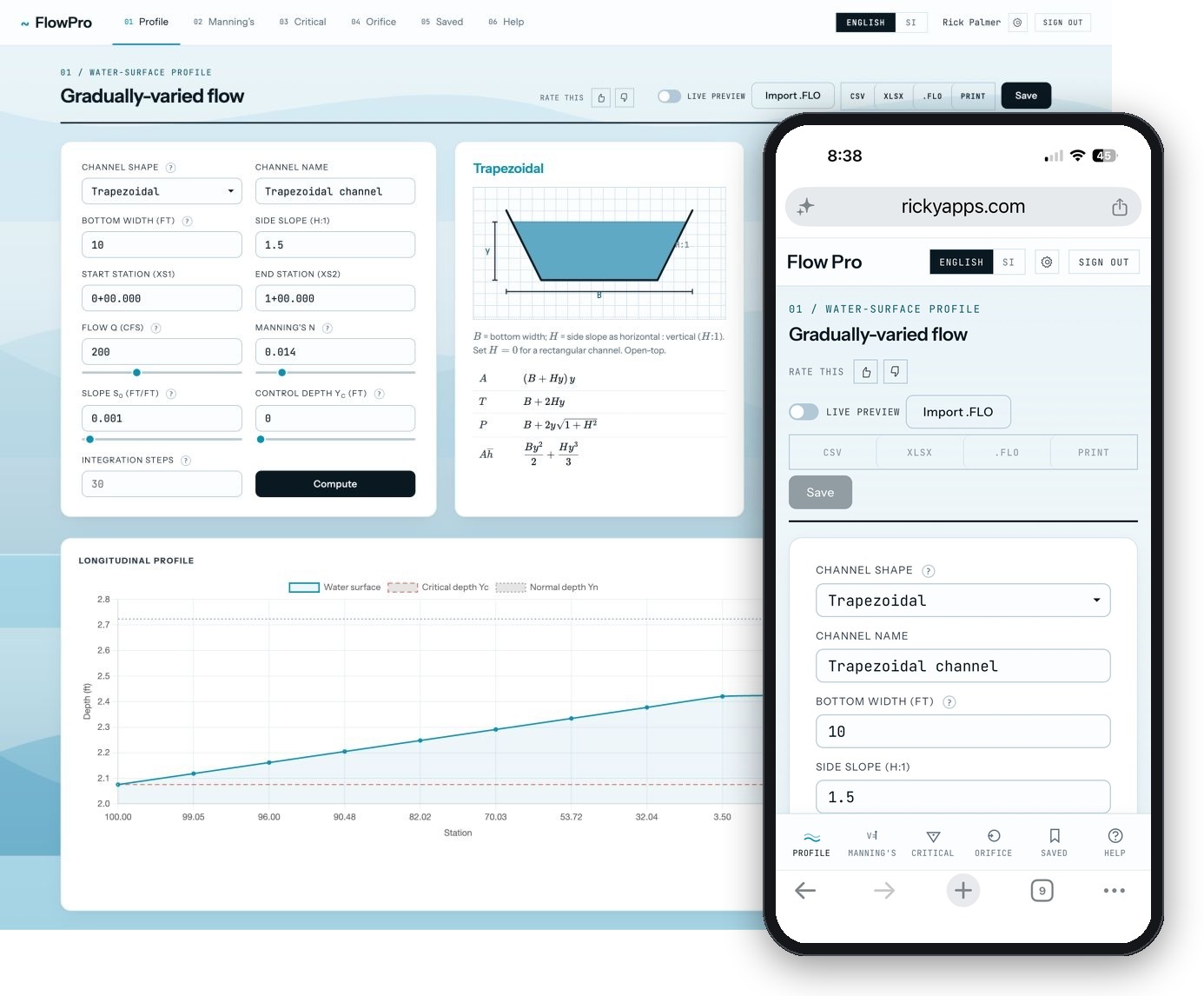
Then, recently — 30 years later — I asked Claude to convert FlowPro into a web app, and it not only did it in a few hours but it created something that was light years beyond the original program. Mind boggling.
My AI Prompts
Not much, honestly. I pointed it at the original VB code, described what FlowPro does (solve gradually-varied flow profiles in open channels), and asked for a modern web port. No spec, no design doc, no re-architecting brief. Just "make this run in a browser."
A few minutes later I had a working prototype — and a few hours later, after a number of iterations, I had a working app complete with a help file documenting every nuance of the engineering calculations.
What I find a little stunning is how much Claude inferred on its own. No framework guidance, no UI direction, no validation rules. It pulled all of that from the original codebase and from the broad strokes of what the tool does.
What this means for legacy code
There's a lot of engineering software from the 1990s — DOS Fortran, early Windows VB, small in-house tools written by engineers who long since retired — that's still load-bearing somewhere, still in use, and increasingly impossible to maintain because nobody reads VB6 anymore. That category of code isn't trapped anymore. One conversation can move it forward.
The result lives at rickyapps.com/flowpro.
Leave a comment